Author: Nathaniel Greer

  • Helios Blockchain On-Chain ETFs: $HLS Token Launch and ETF-Native Layer 1 Guide 2026

    Helios Blockchain On-Chain ETFs: $HLS Token Launch and ETF-Native Layer 1 Guide 2026

    In the evolving landscape of blockchain finance, Helios blockchain emerges as a pioneering force, positioning itself as the ETF-native Layer 1 designed specifically for on-chain ETFs. With its native token $HLS trading at $0.002095 as of February 22,2026, showing a 24-hour change of $-0.000140 (-0.0627%), Helios bridges traditional exchange-traded funds with decentralized technology. This platform enables investors to create and manage diversified portfolios natively on-chain, incorporating crypto assets, stablecoins, and real-world assets without the fragmentation typical of DeFi protocols.

    Helios Blockchain (HLS) Live Price

    Powered by TradingView


    Helios redefines portfolio management by treating ETFs as first-class primitives. Users bridge assets once and gain exposure to automated, multi-chain baskets featuring AI balancing and programmable yield. This approach appeals to conservative investors seeking the familiarity of tokenized ETFs while harnessing blockchain efficiency.

    Core Architecture of Helios as ETF-Native Layer 1

    At its foundation, Helios operates as a modular Layer 1 blockchain engineered for automated, diversified portfolios. Unlike general-purpose chains, it embeds ETF mechanics directly into the protocol. Multi-asset security ensures collateralized positions, while i-PoSR consensus likely optimizes staking for portfolio holders. The network supports EVM compatibility, allowing seamless deployment of smart contracts tailored for crypto ETF investments.

    Funding underscores institutional confidence: $19 million raised, including $15 million from Bolts Capital and $4 million via launchpads like Polkastarter and DAO Maker. Mainnet launch slated for Q1 2026 will integrate $HLS fully, transitioning from current exchange trading on platforms such as KuCoin, BingX, MEXC, Weex, and LBank.

    $HLS Token Launch Mechanics and Exchange Availability

    The $HLS token launched on December 19,2025, marking a milestone for Helios $HLS launch. Priced now at $0.002095, with a 24-hour high of $0.002679 and low of $0.002036, it reflects measured market entry amid broader crypto volatility. Trading volume stands at levels supporting liquidity on Tier-1 venues, positioning $HLS for growth as mainnet activates.

    Token utility centers on governance, staking for yield optimization, and fees within ETF operations. Holders participate in portfolio curation, voting on asset inclusions from crypto to RWAs. This design incentivizes long-term alignment, echoing principles where fundamentals drive value over speculative surges.

    Helios differentiates by automating rebalancing via AI-driven oracles, reducing manual intervention risks. Investors avoid single-token exposure, instead owning protocol-managed baskets that adjust to market conditions on-chain.

    Strategic Advantages for On-Chain ETF Investors

    For blockchain investors and traditional finance professionals, Helios offers regulatory-compliant exposure through tokenized ETFs. Programmable yields compound returns automatically, while cross-chain interoperability expands asset pools beyond native ecosystems.

    Helios (HLS) Price Prediction 2027-2032

    Annual forecasts post-2026 mainnet launch and ETF adoption, considering market cycles, regulatory factors, and adoption trends

    Year Minimum Price Average Price Maximum Price
    2027 $0.001 $0.008 $0.035
    2028 $0.003 $0.025 $0.120
    2029 $0.010 $0.075 $0.350
    2030 $0.025 $0.200 $0.900
    2031 $0.060 $0.500 $2.00
    2032 $0.150 $1.20 $4.00

    Price Prediction Summary

    HLS token, powering the ETF-native Layer 1 blockchain, is projected to see significant appreciation from its current $0.002 level following the Q1 2026 mainnet launch. Average prices could reach $1.20 by 2032 in base scenarios, with maximums up to $4.00 in bullish conditions driven by institutional ETF adoption and bull markets.

    Key Factors Affecting Helios Price

    • Q1 2026 mainnet launch enabling native ETF primitives and i-PoSR consensus
    • Institutional adoption of on-chain ETFs via partnerships like Bolts Capital
    • Regulatory clarity on crypto ETFs boosting legitimacy and inflows
    • Broader crypto market cycles, including post-2028 BTC halving bull run
    • Technological edges in AI-balanced portfolios, multi-chain support, and programmable yield
    • Competition from other L1s and potential delays in adoption as bearish risks
    • $19M funding providing runway for development and listings on Tier-1 exchanges

    Disclaimer: Cryptocurrency price predictions are speculative and based on current market analysis.
    Actual prices may vary significantly due to market volatility, regulatory changes, and other factors.
    Always do your own research before making investment decisions.

    Current metrics reveal resilience: despite a slight 24-hour dip to $0.002095, 24-hour volume of approximately $34,743 signals steady interest. As mainnet nears, $HLS positions to capture demand for structured products in a maturing crypto market.

    Patience remains key; Helios prioritizes robust infrastructure over rapid token pumps, aligning with sustainable growth in on-chain finance.

    Portfolio managers transitioning from Wall Street will appreciate Helios’s emphasis on compliance and transparency. Every rebalance logs immutably, providing audit trails superior to off-chain funds. This setup mitigates counterparty risks inherent in centralized custodians, fostering trust in ETF blockchain technology.

    Helios Blockchain Key Milestones: Funding to ETF Rollouts (2025-2026)

    Secured $19M in Funding ๐Ÿ’ฐ

    2025

    Helios raises $15 million commitment from Bolts Capital and $4 million through launchpads like Polkastarter and DAO Maker to develop the ETF-native Layer 1 blockchain.

    $HLS Token Launches on Major Exchanges ๐Ÿš€

    December 19, 2025

    Native $HLS token goes live for trading on Tier-1 exchanges including KuCoin, BingX, MEXC, Weex, and LBank, enabling access to the ETF-native platform.

    Mainnet Launch ๐Ÿ”—

    Q1 2026

    Helios mainnet deploys, integrating $HLS as the native token and unlocking on-chain ETFs as first-class primitives with multi-chain portfolio automation.

    Market Performance Update ๐Ÿ“ˆ

    February 22, 2026

    $HLS price at $0.002095 (24h change: $-0.000140 or -0.0627%; high: $0.002679, low: $0.002036; volume: $34743.27), showcasing post-launch resilience.

    On-Chain ETF Product Rollouts ๐Ÿ“Š

    2026

    Rollout of ETF-native products with multi-asset security, AI balancing, programmable yield, and diversified crypto/RWA portfoliosโ€”all on-chain.

    Building and Deploying On-Chain ETFs on Helios

    Creating an ETF on Helios starts with defining a basket: select cryptos like BTC and ETH, stablecoins such as USDC, or RWAs tokenized via partners. The protocol’s smart contracts handle weighting, automated via AI oracles that monitor volatility and correlations. Developers deploy via EVM tools, customizing rules for yield farming or lending integrations.

    For everyday investors, no coding required. User interfaces, expected post-mainnet, simplify basket curation. Stake $HLS to earn governance rights and yield boosts, turning passive holding into active portfolio enhancement. This democratizes tokenized ETFs, lowering barriers compared to bespoke DeFi strategies.

    Consider a sample portfolio: 40% blue-chip cryptos, 30% stables, 20% RWAs, 10% emerging tokens. Helios rebalances quarterly or on triggers like 10% deviations, optimizing Sharpe ratios on-chain. Such precision suits institutional mandates seeking crypto exposure without direct custody.

    @josephweb3 @helios_layer1 yep size when

    @KGeNazeemali12 @helios_layer1 love that no micromanagement vibe with $HLS automation

    @helios_layer1 ETF-native rails will redefine automated portfolio management in DeFi.

    @DaPrieXt @helios_layer1 yep exactly portfolios as primitives is the move

    @charlie_pnx @helios_layer1 yep cautious optimism is smart, but execution so far looking clean af

    @xCryptoAlucard @helios_layer1 yep this beta feels clean af

    @TheHODLerMystic @helios_layer1 yep exactly, composable etfs as base layer primitives is the real alpha here

    @DF_chuddy @helios_layer1 yep feels rushed af

    @gnguyen69 @helios_layer1 yep ambitious af but if they pull off base layer cross-chain automation without the usual mess it’s gg for defi etfs

    @NKLinhzk @helios_layer1 yep solid bet, growth gonna be crazy when mainnet hits full send

    @PhiTran2612 @helios_layer1 yep size when

    @AnhHc8 @helios_layer1 yep solid infra bet, positioning early is the move

    @0xweb3engineer @helios_layer1 yep gonna ape a lil too feels like solid infra positioning

    @karakalemhikmet @helios_layer1 yep exactly, ETF-native rails + base layer automation is massive for defi portfolios

    Market Positioning and Competitive Edge

    Helios stands apart from DeFi aggregators by natively embedding ETF logic, avoiding composability pitfalls that amplify losses in cascades. Competitors like Set Protocol offer tokenized baskets, but lack Layer 1 sovereignty. Helios’s i-PoSR consensus prioritizes portfolio stakers, aligning security with user incentives.

    At $0.002095, $HLS trades with a modest volume reflecting its early stage, yet funding from Bolts Capital signals conviction. Exchanges like KuCoin provide accessible entry, while mainnet will unlock native staking rewards projected at competitive APYs.

    Regulatory tailwinds favor Helios. As tokenized securities gain clarity, ETF-native chains position ahead of generalists. Investors eyeing crypto ETF investments gain diversified alpha without timing individual assets.

    Navigating Risks in Helios Investments

    No blockchain escapes smart contract vulnerabilities; Helios counters with modular audits and phased rollouts. Oracle reliance for AI balancing introduces centralization risks, though multi-oracle feeds mitigate this. Market risks persist: at $0.002095 after a 24-hour low of $0.002036, $HLS mirrors sector sentiment.

    Diversification remains paramount. Allocate modestly to emerging Layer 1s like Helios, balancing with established ETFs. Monitor mainnet metrics post-Q1 2026 for adoption signals, such as total value locked in portfolios.

    Helios $HLS FAQs: Unpacking ETF-Native Layer 1 Essentials

    What is an ETF-native Layer 1 blockchain?
    Helios is an ETF-native Layer 1 blockchain designed from the ground up to integrate traditional ETF functionalities directly into blockchain primitives. It enables the creation, management, and automation of on-chain ETFs and diversified portfolios, including multi-asset security, AI-driven balancing, and programmable yield. Unlike fragmented DeFi protocols, Helios treats automated, multi-chain portfolios as native features, bridging crypto assets into ETF-style baskets managed at the protocol level for seamless ownership and efficiency.
    ๐Ÿ”—
    What is the utility of the $HLS token?
    The $HLS token is the native cryptocurrency of the Helios blockchain, launched on December 19, 2025, and currently trading on major exchanges such as KuCoin, BingX, MEXC, Weex, and LBank. As of February 22, 2026, its price stands at $0.002095 USD, reflecting a 24-hour change of -0.0627%. Upon mainnet launch in Q1 2026, $HLS will power network transactions, staking, and governance within the ETF-native ecosystem, supporting automated portfolio management and on-chain financial products.
    ๐Ÿ’ฐ
    When is the Helios mainnet scheduled to launch?
    The Helios mainnet is scheduled for launch in Q1 2026. This milestone will make $HLS fully native to the Helios chain, unlocking its complete utility for ETF-native applications. Prior to mainnet, the token is available on centralized exchanges. Helios has raised $19 million in funding, including commitments from Bolts Capital, positioning it strongly for this rollout. Investors should monitor official announcements for exact timing, as delays are possible in blockchain development.
    ๐Ÿ“…
    Is Helios EVM compatible?
    Helios is a modular, ETF-native Layer 1 blockchain utilizing innovative consensus like i-PoSR, optimized for automated portfolios rather than general-purpose smart contracts. Public sources describe it as engineered for on-chain ETFs without explicit confirmation of full EVM compatibility. Developers should refer to official documentation closer to the Q1 2026 mainnet launch for interoperability details, ensuring alignment with multi-chain portfolio needs.
    โš™๏ธ
    What are the main risks of investing in Helios or $HLS?
    Investing in Helios ($HLS) carries typical cryptocurrency risks, including high volatilityโ€”as seen in its current price of $0.002095 USD and 24-hour change of -0.0627%. Pre-mainnet status introduces execution risks, potential delays beyond Q1 2026, and regulatory uncertainties around on-chain ETFs. Market adoption, competition from other Layer 1s, and broader crypto downturns could impact value. Always conduct thorough due diligence, consider diversification, and only invest what you can afford to lose.
    โš ๏ธ

    Helios embodies disciplined innovation, where on-chain ETFs evolve finance methodically. As $HLS stabilizes around $0.002095, early positions reward those prioritizing protocol strength over fleeting pumps. Fundamentals here promise enduring utility in a portfolio-first blockchain era.

  • Ondo Finance Tokenized US Stocks and ETFs on Solana: 24/7 Trading Guide

    Ondo Finance Tokenized US Stocks and ETFs on Solana: 24/7 Trading Guide

    Ondo Finance has marked a pivotal moment in on-chain finance by launching over 200 tokenized U. S. stocks and ETFs on the Solana blockchain as of January 21,2026. This expansion of Ondo Global Markets delivers tokenized US stocks Solana access to global investors, featuring blue-chip names like Apple (AAPL), Nvidia (NVDA), and Meta (META), alongside popular ETFs such as SPY and QQQ. Each token maintains a strict 1: 1 backing with the underlying asset, custodied by licensed U. S. broker-dealers, ensuring transparency and regulatory alignment.

    Ondo (ONDO) Live Price

    Powered by TradingView


    Ondo Finance Solana ETFs Unlock Continuous Market Exposure

    Solana’s high-throughput infrastructure now hosts Ondo Finance Solana ETFs and stocks, enabling 24/7 minting and redemption five days a week. Traditional markets close daily, but these on-chain equivalents trade around the clock, with near-instant settlement. For non-U. S. investors, this means bypassing time zone barriers and gaining exposure to Wall Street liquidity without intermediaries. Ondo’s ONDO token, currently at $0.2807 with a 24-hour change of -0.000690%, underpins the ecosystem, reflecting measured growth amid broader market dynamics.

    The platform’s arrival on Solana taps into 3.2 million daily active users, blending DeFi efficiency with TradFi-grade assets. Commodities and funds join the roster, broadening portfolios beyond equities. Investors can transfer tokens seamlessly across wallets, fostering composability in DeFi protocols.

    Mechanics of On-Chain Stock Trading with Custody-Backed Security

    On-chain stock trading via Ondo operates through a straightforward process: users deposit fiat or stablecoins to mint tokens representing real shares. These are held in custody by compliant U. S. entities, with proof-of-reserves verifiable on-chain. Redemption reverses the flow, delivering underlying value promptly. Solana’s speed minimizes slippage, a common pain point in fragmented markets.

    Ondo Global Markets brings the liquidity of traditional finance to on-chain equities.

    This model prioritizes investor protection, aligning with my long-held view that robust custody trumps speculative yields. Unlike unbacked synthetics, Ondo’s approach mirrors ETF structures familiar to institutional players, reducing counterparty risk.

    Tune in for a special Solana x Ondo Spaces.

    Ondo Finance President @iandebode joins Solana Foundation’s Head of Institutional Growth @nickducoff to discuss tokenized stocks & ETFs on Solana.

    Today at 11:30am ET. ๐Ÿ‘‡

    https://t.co/FsUZVhzhJd

    Strategic Advantages for Global Portfolio Diversification

    Tokenized assets on Solana address key frictions in cross-border investing. Asian traders, for instance, access U. S. opens without delay, while Europeans trade overnight sessions. The 24/7 availability, coupled with Solana’s low fees, democratizes Ondo tokenized ETFs 2026 for retail and sophisticated allocators alike.

    • Instant settlement eliminates T and 1 delays.
    • Full backing ensures redeemability.
    • Composability integrates with lending, yield farming.
    • Regulatory custodians provide peace of mind.

    ONDO’s price stability at $0.2807 signals ecosystem maturity, even as it navigates a 24-hour low of $0.2687 and high of $0.2950. Fundamentals like adoption drive value over volatility.

    Ondo Finance (ONDO) Price Prediction 2027-2032

    Conservative estimates based on tokenized US stocks/ETFs growth on Solana and RWA adoption trends

    Year Minimum Price Average Price Maximum Price
    2027 $0.35 $0.70 $1.40
    2028 $0.55 $1.10 $2.20
    2029 $0.80 $1.70 $3.40
    2030 $1.10 $2.50 $5.00
    2031 $1.50 $3.60 $7.20
    2032 $2.00 $5.00 $10.00

    Price Prediction Summary

    Following the 2026 launch of Ondo Global Markets on Solana with 200+ tokenized U.S. stocks and ETFs, ONDO is projected for steady growth. Average prices could rise from $0.70 in 2027 to $5.00 by 2032 (over 600% cumulative), with min/max reflecting bearish corrections and bullish adoption surges amid market cycles.

    Key Factors Affecting Ondo Finance Price

    • Ondo Global Markets expansion on Solana enabling 24/7 tokenized equities trading
    • Solana TVL growth and DeFi ecosystem expansion
    • Rising institutional adoption of Real World Assets (RWAs)
    • Regulatory clarity for tokenized securities
    • Crypto bull cycles and macroeconomic tailwinds
    • Technological improvements in on-chain settlement and custody
    • Competition from other RWA projects
    • Equity market performance influencing tokenized assets

    Disclaimer: Cryptocurrency price predictions are speculative and based on current market analysis.
    Actual prices may vary significantly due to market volatility, regulatory changes, and other factors.
    Always do your own research before making investment decisions.

    Bridging these worlds demands patience; hype fades, but structural shifts endure. Ondo’s Solana integration positions it as a cornerstone for tokenized real-world assets, appealing to those seeking diversified, compliant exposure.

    Solana’s scalability amplifies these benefits, processing thousands of transactions per second at fractions of a cent. For institutional investors I advise, this translates to efficient portfolio rebalancing without the drag of legacy settlement systems. Retail participants gain similar efficiencies, positioning tokenized US stocks Solana as a viable alternative to offshore brokers.

    Navigating 24/7 Trading: A Practical Step-by-Step

    Engaging with Ondo Global Markets requires a Solana-compatible wallet and familiarity with DeFi interfaces. The process emphasizes security and simplicity, core tenets in my practice of recommending only vetted protocols. Here’s how investors can participate directly.

    24/7 Minting Guide: Tokenized US Stocks & ETFs on Ondo Solana

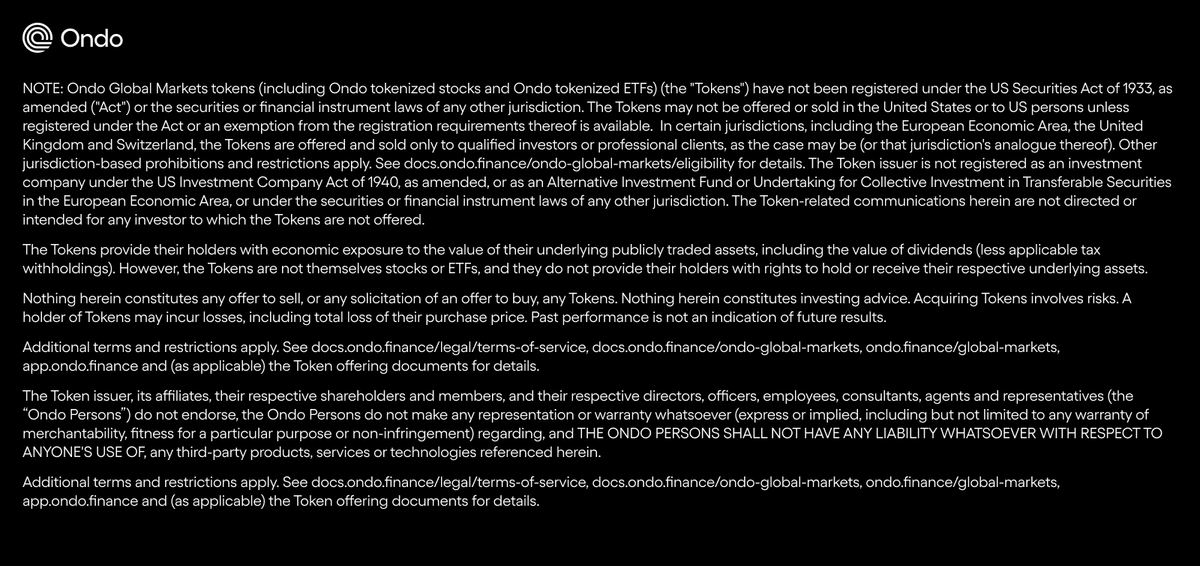
    clean UI screenshot of Ondo Global Markets Solana homepage with stock listings
    Visit Ondo Global Markets
    Access the official Ondo Finance Global Markets platform on Solana via app.ondo.finance. Switch to the Solana network if prompted. This platform offers over 200 tokenized U.S. stocks and ETFs, fully backed 1:1 by custodied assets.
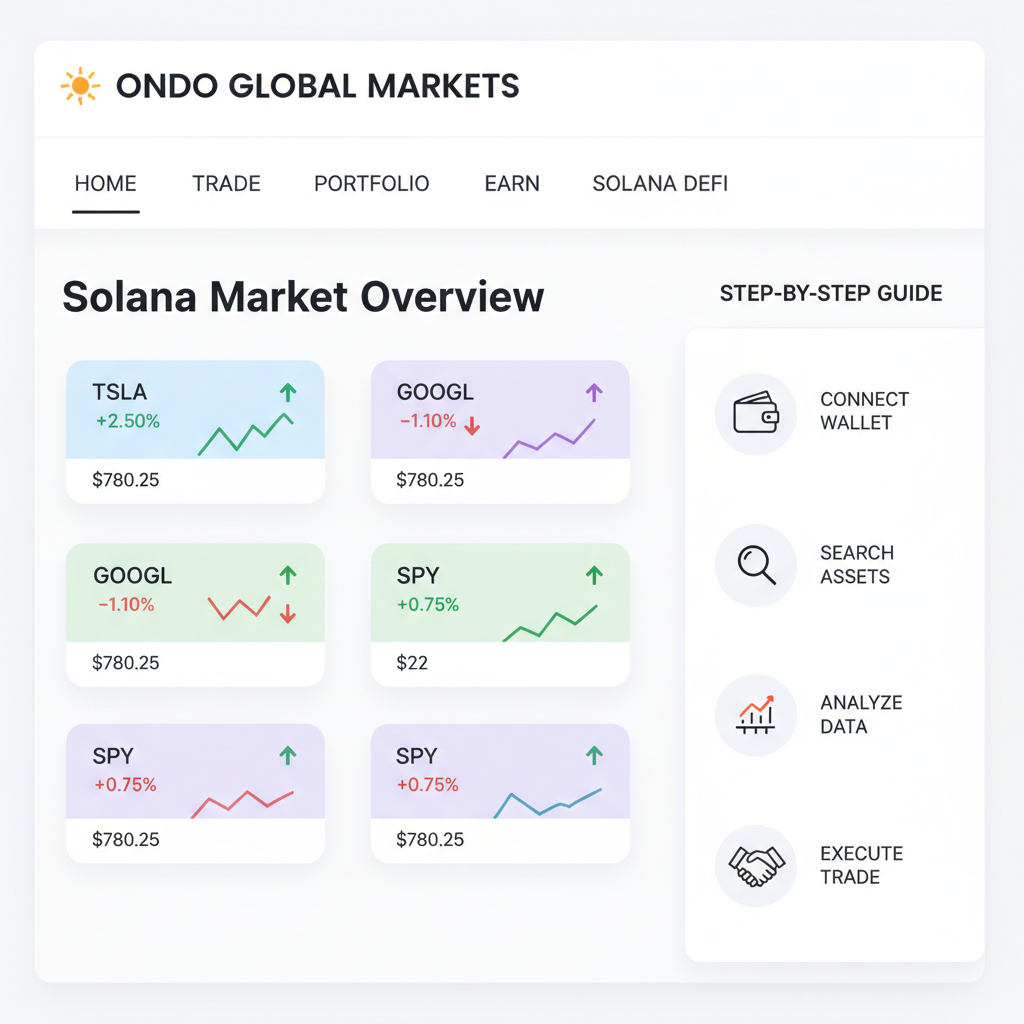
    Solana wallet connection popup on Ondo dApp interface
    Connect Solana Wallet
    Click the ‘Connect Wallet’ button in the top right. Select a compatible Solana wallet like Phantom or Solflare. Approve the connection to securely link your wallet to the dApp.
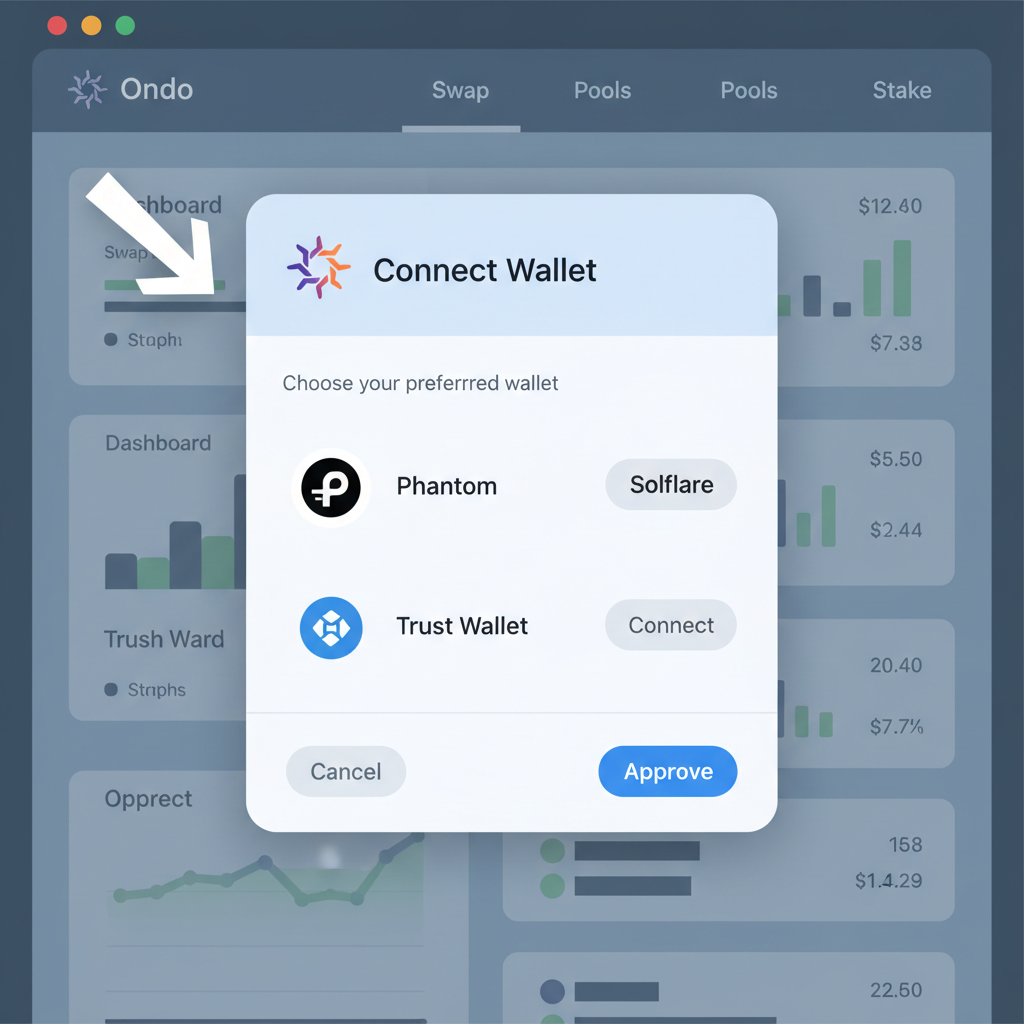
    Phantom wallet interface showing USDC balance on Solana
    Fund Wallet with USDC
    Ensure your Solana wallet holds sufficient USDC. Bridge USDC from other networks using trusted bridges like Wormhole if necessary. Deposits fuel the minting process.
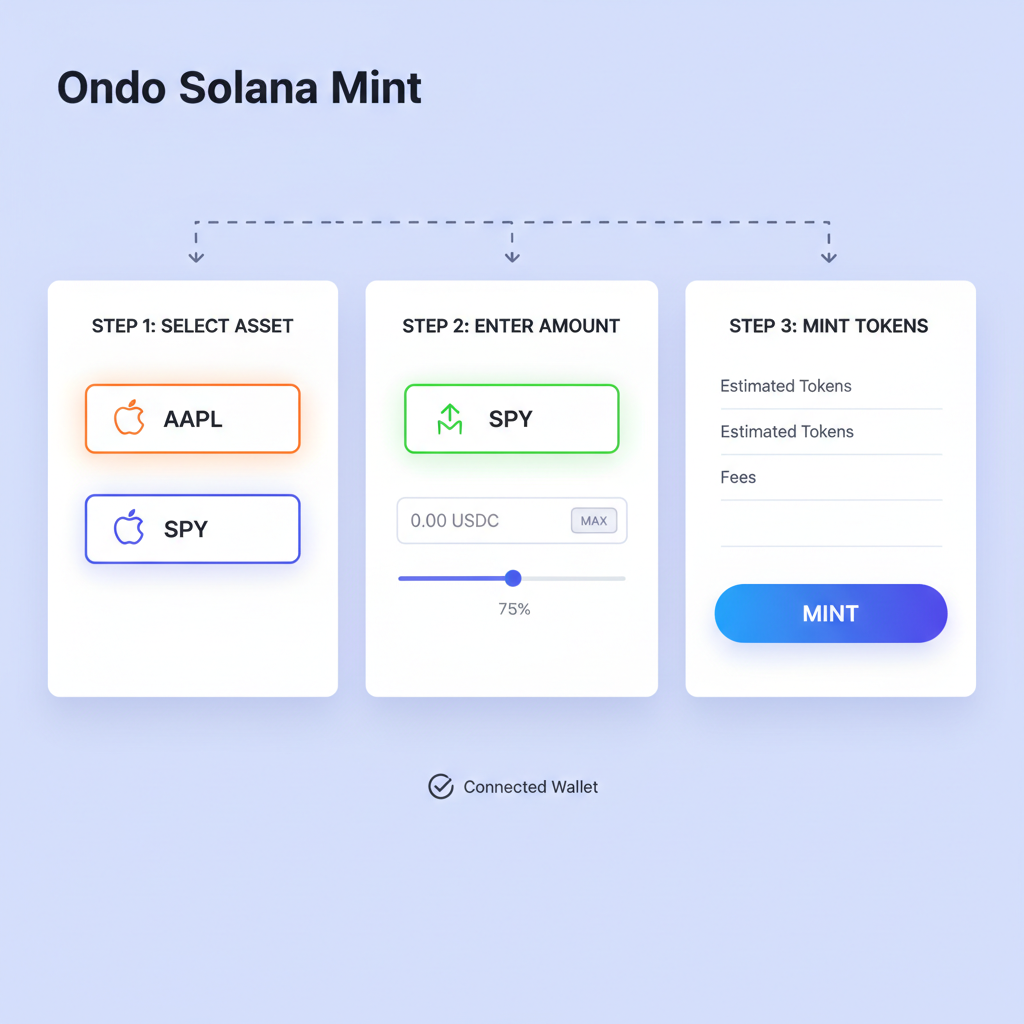
    Ondo Solana mint page with AAPL and SPY asset selectors highlighted
    Navigate to Mint Section
    Locate the ‘Mint’ tab or section. Browse the extensive list of over 200 tokenized assets, including popular ones like AAPL (Apple) and SPY (S&P 500 ETF).
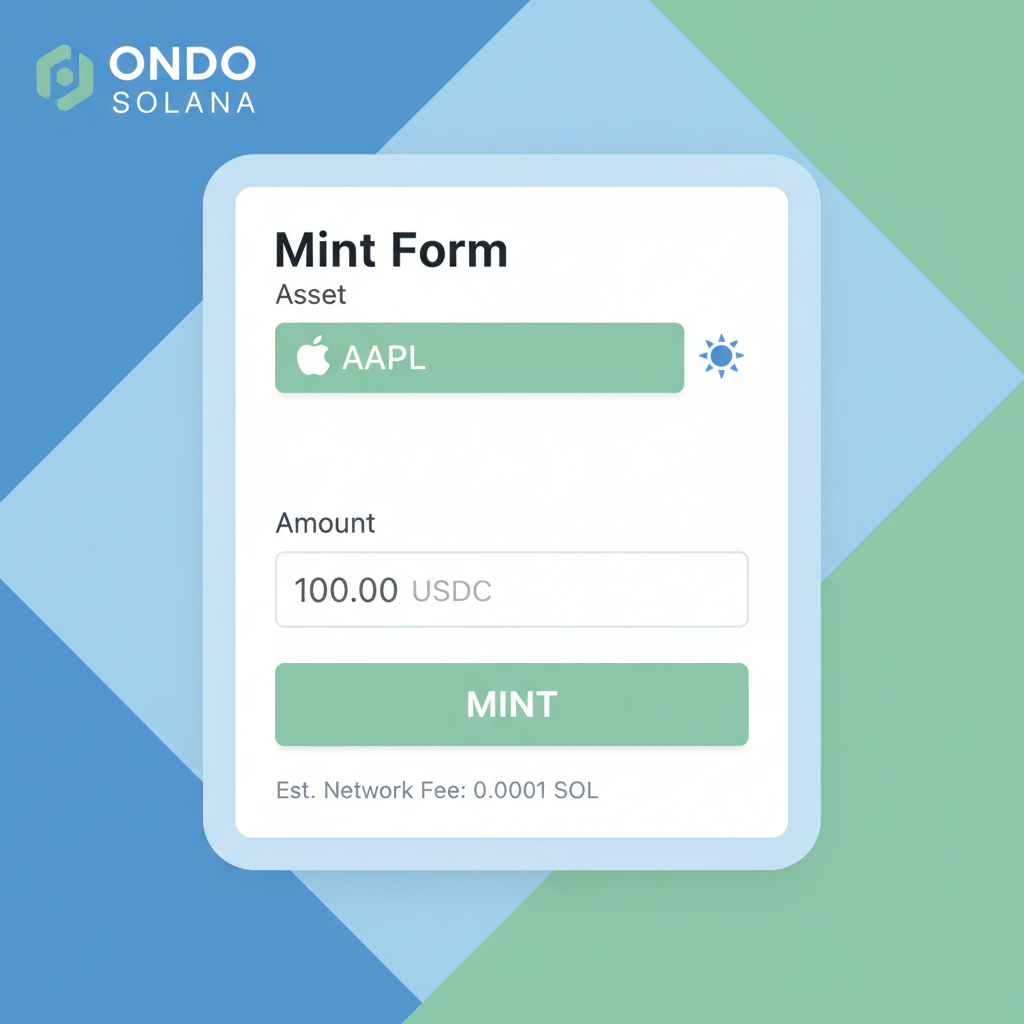
    mint form on Ondo Solana with AAPL selected and amount input field
    Select Asset & Enter Amount
    Choose your desired stock or ETF, such as AAPL or SPY. Input the USDC amount to mint. Review the 1:1 backing and current rates before proceeding.
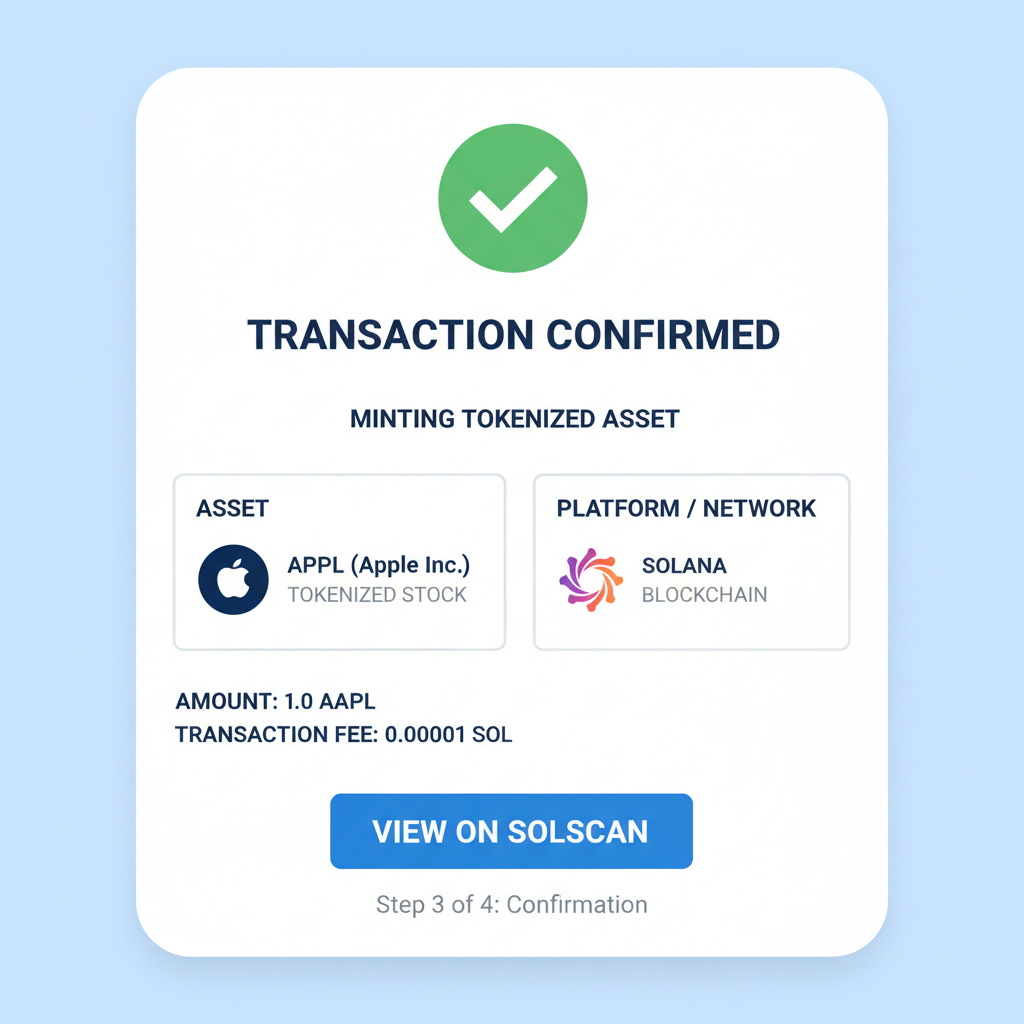
    transaction confirmation screen for minting tokenized AAPL on Solana
    Confirm & Mint Tokens
    Approve the transaction in your wallet. Minting occurs 24 hours a day, five days a week, with near-instant on-chain settlement. Tokens are now in your wallet for 24/7 trading.
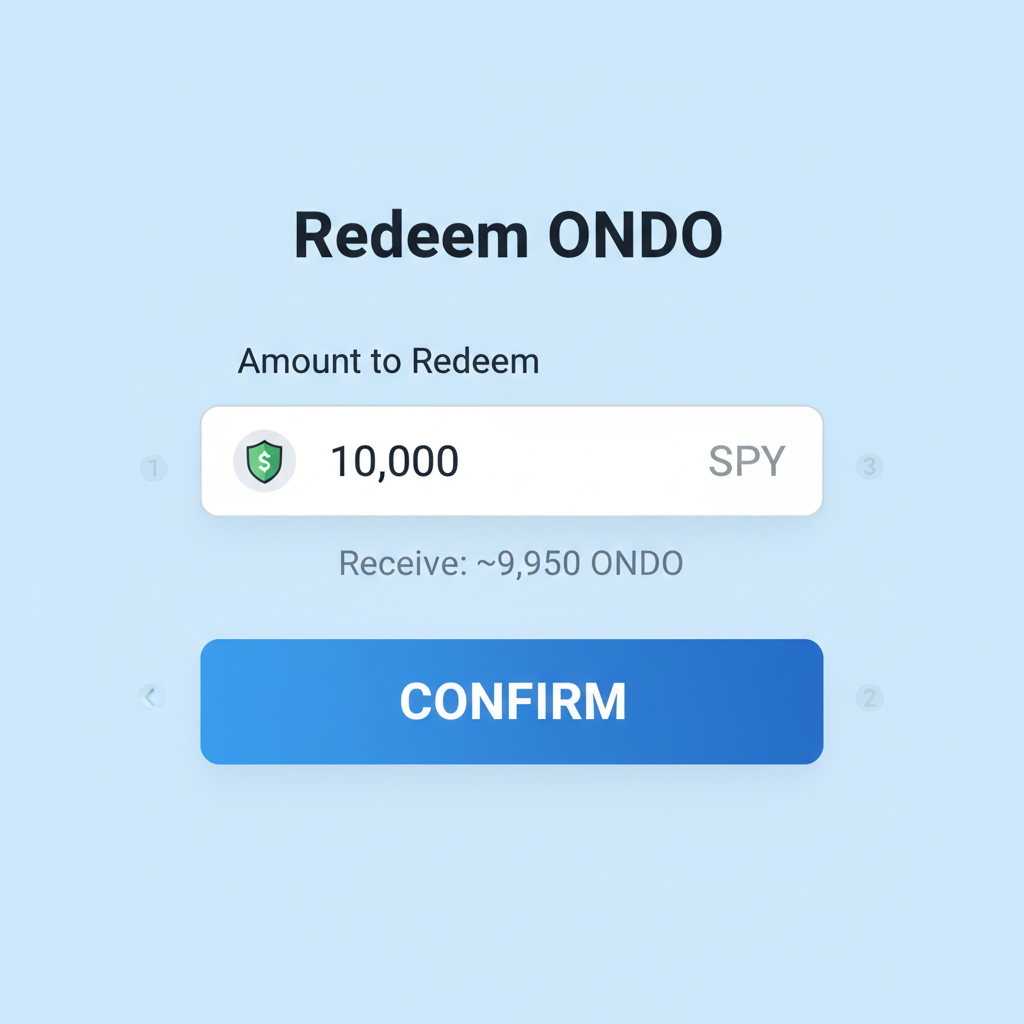
    Ondo Solana redeem interface with SPY token input and confirm button
    Redeem Tokens (Optional)
    To redeem, go to the ‘Redeem’ tab, select your tokens (e.g., AAPL), enter amount, and confirm. Receive USDC back during supported hours, maintaining 1:1 redeemability.

    Once minted, tokens like those tracking Nvidia (NVDA) or QQQ integrate into broader DeFi strategies, such as collateral for loans on platforms like Marginfi or Kamino. This composability sets on-chain stock trading apart from siloed TradFi products. Fees remain under $0.01 per transaction, preserving capital during volatile sessions.

    Redemption follows suit: burn tokens for stablecoin payout, with custodians handling share liquidation during U. S. market hours. Non-U. S. users appreciate the decoupling from NYSE schedules, trading AAPL at 3 a. m. UTC if sentiment shifts. ONDO at $0.2807, despite a 24-hour dip to $0.2687, reflects protocol utility over speculative fervor.

    @JUPspanish @OndoFinance @solana @OndoFoundation @toly @luminaries @capitalmarkets @Tesla @nvidia Voy un segundo ๐Ÿ™

    @icefrog_sol @OndoFinance @solana @OndoFoundation @toly @luminaries @capitalmarkets @Tesla @nvidia Who ate who?

    @Treki33 @OndoFinance @solana @OndoFoundation @toly @luminaries @capitalmarkets @Tesla @nvidia Last time I checked, we say quadrillionsss now ๐Ÿค

    @VipRoseTr @OndoFinance @solana @OndoFoundation @toly @luminaries @capitalmarkets @Tesla @nvidia Should have used this sexy visual https://t.co/Luay4PAFeg
    Tweet media

    Risks, Rewards, and Regulatory Guardrails

    No innovation lacks friction. Smart contract vulnerabilities persist, though Ondo’s audits by top firms mitigate this. Custodial reliance introduces minimal counterparty exposure, far below unregulated synthetics. U. S. regulatory scrutiny on tokenized RWAs looms, but licensed broker-dealers like those partnering Ondo provide a compliant foundation.

    • Market risk mirrors underlying assets; no leverage illusions here.
    • Liquidity pools grow daily, backed by 3.2 million Solana actives.
    • Geopolitical events may pause redemptions, aligned with TradFi norms.

    I counsel diversification: allocate 5-15% to tokenized equities within crypto portfolios, monitoring ONDO’s $0.2807 price as a sentiment gauge. Highs near $0.2950 show resilience; patience rewards those avoiding FOMO traps.

    Compared to Ethereum or BNB Chain counterparts, Solana’s speed edges ahead for high-frequency needs. Yet, cross-chain bridges enable portfolio unity, a trend institutional desks increasingly adopt. Ondo’s 24/7 framework exemplifies this evolution, blending Wall Street depth with blockchain agility.

    Ondo Finance Solana ETFs: Answering Key Investor Queries

    Ondo Solana Tokenized Stocks: Essential FAQs Unlocked

    What are Ondo tokenized US stocks on Solana?
    Ondo Finance has expanded its Ondo Global Markets platform to the Solana blockchain, offering over 200 tokenized U.S. stocks and ETFs. These include major equities like Apple (AAPL), Nvidia (NVDA), and Meta (META), as well as popular ETFs such as SPY and QQQ. Designed for non-U.S. investors, these tokens provide on-chain access to traditional U.S. markets with Solana’s high-speed infrastructure, enabling seamless integration into DeFi ecosystems while maintaining exposure to real-world assets.
    ๐Ÿ“ˆ
    How does 24/7 trading work with Ondo tokenized stocks on Solana?
    Ondo tokenized stocks on Solana support 24/7 trading and near-instant settlement through the blockchain’s efficient infrastructure. Users can mint and redeem tokens 24 hours a day, five days a week, with the ability to transfer them on-chain anytime. This provides continuous liquidity and access to U.S. equities for global investors, bridging traditional finance with blockchain speed without traditional market hour restrictions.
    โฐ
    Is the custody for Ondo tokenized stocks 1:1 backed?
    Yes, each Ondo tokenized stock or ETF on Solana is fully backed 1:1 by the underlying asset. The corresponding U.S. stocks or ETFs are held in custody by licensed U.S. custodial broker-dealers, ensuring transparency and security. This backing mechanism guarantees that token holders have direct equivalence to the real-world assets, minimizing counterparty risk in the tokenized ecosystem.
    ๐Ÿ”’
    What is the role of the ONDO token at $0.2807?
    The ONDO token, currently priced at $0.2807 (24h change: $-0.000200 (-0.000690%), 24h high: $0.2950, low: $0.2687), serves as the native governance and utility token for the Ondo Finance ecosystem. It enables participation in protocol governance, staking for rewards, and access to premium features within Ondo Global Markets, including tokenized U.S. stocks on Solana. ONDO holders can influence platform development while benefiting from the growing adoption of on-chain real-world assets.
    ๐Ÿช™
    What is the redemption process for Ondo tokenized stocks on Solana?
    The redemption process for Ondo tokenized stocks on Solana allows users to exchange tokens back for the underlying U.S. stock or ETF 24 hours a day, five days a week. Token holders initiate redemption through the Ondo platform, where tokens are burned, and the equivalent asset is released from custody with licensed U.S. broker-dealers. This ensures a straightforward, secure process with near-instant on-chain settlement, maintaining 1:1 backing throughout.
    ๐Ÿ”„

    Global adoption hinges on education. Non-U. S. investors, long sidelined by KYC hurdles, now claim U. S. market parity. ETFs like SPY offer broad exposure, while single stocks suit conviction plays. Solana’s ecosystem, from oracles to DEXs, ensures robust pricing feeds, minimizing oracle risks that plague lesser protocols.

    Looking ahead, expect expansions: more commodities, perhaps international equities. ONDO’s steady $0.2807 amid -0.000690% daily flux underscores a maturing asset, primed for tokenized RWA dominance. Investors blending TradFi discipline with DeFi innovation will find enduring value here, as structural tailwinds overpower transient noise.