
How ETF flows reshape crypto markets
The traditional four-year Bitcoin halving cycle has structurally altered. For over a decade, market drivers were dominated by retail speculation and predictable post-halving supply shocks. Today, institutional ETF inflows have shifted the center of gravity toward steady accumulation and distribution by regulated financial vehicles. This transition means the old cycle rules no longer apply in the same way.
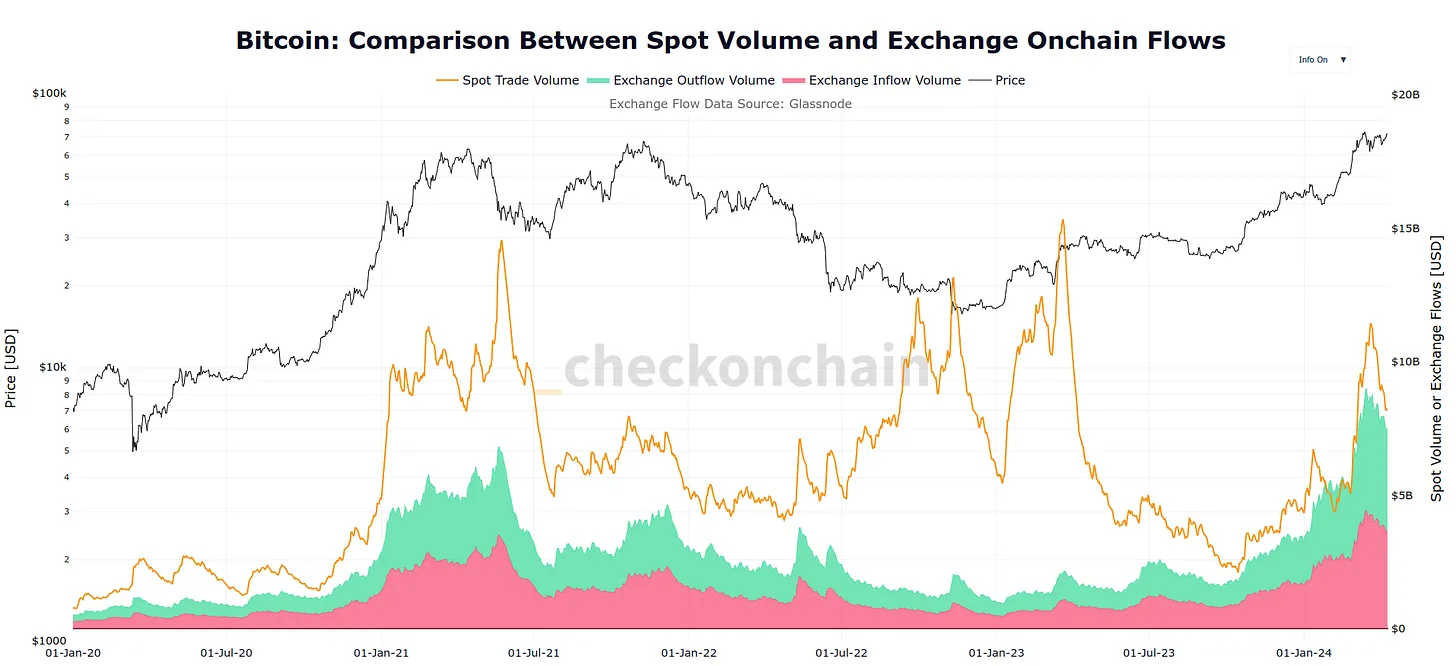
On-chain data confirms this shift. Metrics like the MVRV Z-Score show that institutions are now absorbing the exchange float, reducing the liquidity available to retail traders. This creates a different market dynamic where price action is less about sudden retail frenzies and more about sustained institutional positioning. The result is a market that is less volatile in the short term but potentially more resilient in the long term.
To visualize this change, consider the divergence between historical halving cycles and recent price action. The chart below shows how Bitcoin's price movement is increasingly decoupled from the traditional halving timeline, reflecting the growing influence of ETF flows.
This structural change is not just a temporary trend. As more traditional finance players enter the crypto space through ETFs, the market's reliance on retail speculation will continue to decline. Understanding this shift is crucial for navigating the new crypto landscape.
Bitcoin ETF inflows tracking metrics
Spot Bitcoin ETFs have crossed the $100 billion assets under management (AUM) threshold, marking a significant milestone in institutional adoption. This volume represents more than just retail interest; it signals a structural shift where traditional finance vehicles are absorbing the exchange float. Early 2026 saw volatility in daily flows, but recent on-chain data indicates that demand has stabilized as large-scale investors position these funds as core portfolio holdings rather than speculative trades.
The market is now dominated by a few key players, with BlackRock’s IBIT and Fidelity’s FBTC leading in total holdings. As these funds mature, the distinction between "hot money" and "sticky capital" becomes clearer. Institutions are less likely to withdraw during minor price dips, creating a floor for ETF valuations that wasn't present in the initial launch months. This stabilization is critical for long-term price discovery, as it reduces the impact of short-term retail sentiment on the broader Bitcoin ecosystem.
To understand the current landscape, it helps to look at the top funds by AUM and their recent inflow trends. The following comparison highlights the disparity in scale and the varying expense ratios that influence institutional preference.
| Fund | AUM (Est.) | 30-Day Net Inflows | Expense Ratio |
|---|---|---|---|
| BlackRock IBIT | $45B | +$2.1B | 0.25% |
| Fidelity FBTC | $22B | +$850M | 0.25% |
| Ark/21Shares ARKB | $3.2B | -$120M | 0.21% |
| Invesco IBIT | $2.8B | +$45M | 0.25% |
The concentration of assets in the top two funds suggests a "winner-take-most" dynamic is settling in. While smaller funds compete on lower fees, they struggle to match the liquidity and brand recognition of the incumbents. For investors tracking Bitcoin ETF inflows, monitoring the net flow differences between these leaders provides a clearer signal of institutional sentiment than the total market average alone.
Ethereum ETF holdings analysis
Ethereum’s role in the ETF landscape diverges sharply from Bitcoin’s, driven by its dual identity as both a store of value and the settlement layer for decentralized applications. While Bitcoin ETFs track a passive asset, Ethereum’s institutional appeal is increasingly tied to the yield generated by staking and the utility of its smart contracts. This structural difference creates a distinct flow dynamic, where capital allocation is influenced not just by price speculation, but by the fundamental economics of network participation.
On-chain metrics reveal that Ethereum ETF holders are accumulating with a longer-term horizon than typical spot traders. The integration of staking rewards into the ETF structure, where available, has attracted yield-seeking institutional capital that views Ethereum as a productive asset rather than a static reserve. This shifts the demand curve; holders are less likely to sell during minor volatility spikes, reducing the sell-side pressure that often plagues purely speculative assets.
Institutional interest is evolving from curiosity to strategic allocation. Major asset managers are positioning Ethereum ETFs as a core component of diversified crypto portfolios, leveraging the network’s upgrade cycle and deflationary tokenomics. As the ecosystem matures, the distinction between holding Ethereum as a commodity and holding it as a technology platform is blurring, making on-chain activity a critical indicator of sustained institutional confidence.
Solana ETF on-chain metrics
The emerging narrative around a Spot Solana ETF centers on the chain’s distinct architectural advantages, particularly its high throughput and low transaction costs. Unlike Bitcoin or Ethereum, Solana’s design allows for significantly higher transaction volumes per second, a metric that directly influences how institutional investors view the asset’s scalability and utility. This structural difference shapes the ETF product itself, positioning it not just as a store of value, but as a gateway to a high-velocity blockchain ecosystem.
On-chain data reveals that Solana’s transaction volume has consistently outpaced many legacy networks, providing a real-time indicator of network activity. For an ETF product, this high throughput is a double-edged sword: it demonstrates robust demand and utility but also requires sophisticated custody and settlement infrastructure to manage the sheer volume of underlying asset movements. Investors are increasingly scrutinizing these on-chain metrics to gauge the health of the Solana network before committing capital through regulated financial products.
To understand the current market sentiment and price action driving these ETF discussions, real-time data is essential. Static price snapshots quickly become obsolete in the volatile crypto market, making provider-backed widgets the standard for accurate analysis.
The integration of Solana into traditional finance also hinges on how its unique consensus mechanism, Proof of History, is audited and verified by custodians. Unlike the energy-intensive Proof of Work seen in Bitcoin, Solana’s approach is often viewed as more efficient, though it introduces different operational risks. ETF providers are carefully evaluating these technical nuances to ensure that the fund can reliably track Solana’s price while maintaining the regulatory compliance expected by institutional clients.
XRP ETF prospects and institutional adoption
XRP has rapidly transitioned from regulatory uncertainty to a cornerstone of the regulated Spot ETF market. In late 2025, the asset attracted significant capital from influential traditional finance names, cementing its place in the institutional allocation conversation. This influx signals a broader acceptance of XRP as a viable bridge asset for cross-border settlements.
The approval process was driven by Ripple’s consistent engagement with the SEC and the clarity provided by the 2023 court rulings. Unlike earlier altcoin ETF attempts, XRP’s legal status allowed issuers to structure products with lower compliance friction. This clarity enabled major asset managers to include XRP in their diversified crypto baskets, expanding its liquidity pool.
Institutional interest is now reflected in on-chain data and trading volumes. The asset’s price action has become increasingly correlated with traditional risk assets, suggesting it is being treated as a standard equity-like exposure rather than a speculative bet. This shift marks a pivotal moment for XRP’s long-term viability.
Frequently asked questions about crypto ETFs
Is XRP going to become an ETF?
XRP is positioning itself as a leading candidate for a regulated Spot ETF. In late 2025, XRP became one of the most actively adopted digital assets in the regulated Spot ETF market, attracting capital from influential traditional finance names and cementing its place in the institutional allocation conversation [src-serp-2].
How do Bitcoin and Ethereum ETF flows differ?
Bitcoin ETFs typically serve as macro-hedge instruments, while Ethereum ETFs often reflect broader blockchain infrastructure sentiment. Tracking net inflows and outflows helps distinguish between speculative trading and long-term institutional accumulation.
What is the primary risk in crypto ETF investing?
The main risk is regulatory uncertainty and market volatility. Unlike traditional assets, crypto ETFs are subject to rapid policy shifts and extreme price swings, requiring careful position sizing and risk management.

No comments yet. Be the first to share your thoughts!